The One Door to Work policy and service delivery model isn’t just a foundational pro-work, generational reform that helps people move from cycles of poverty to self-sufficiency. It’s one of the strongest structural tools states can deploy in the “war on fraud.”
To win this war, states need more than tougher slogans and after-the-fact investigations. They need a modern structure that prevents fraud at the front end—by eliminating silos, standardizing oversight, integrating eligibility and data systems, and creating clear ownership for outcomes and program integrity. One Door to Work is exactly that structural reform.
The Safety Net’s Fragmented Framework Invites Fraud
Right now, most states operate a sprawling web of over 50 anti-poverty programs that are jointly funded by the federal government but administered across multiple state and local agencies. Each agency collects different information (and often different outcome metrics, if any), uses different vendors and subcontractors, and runs separate intake and eligibility systems. The result is a fragmented accountability environment in which no one has full visibility into the taxpayer dollars flowing out the door.
That fragmentation isn’t just inefficient—it’s a fraud enabler. As P.J. O’Rourke said, “‘complexity is fraud’.… [W]hen someone creates a system in which you can’t tell whether or not you’re being fooled, you’re being fooled.”
When programs are siloed and oversight varies from agency to agency, bad actors can venue-shop for the weakest controls, exploit gaps between systems, and hide behind bureaucratic complexity. Multiple intakes, inconsistent identity verification, and disconnected data create exactly the blind spots fraudulent providers look for: opportunities to double-bill, fabricate services, inflate hours, or keep collecting payments after eligibility should have ended.
Utah Shows What’s Possible with “One Door to Work”
One state has built a very different model: Utah. Utah consolidates workforce and social services under a single agency—the Department of Workforce Services—with a clear focus on work, accountability, and upward mobility. Instead of forcing residents to navigate a maze, Utah gives them one door to walk through and a case manager responsible for building an employment plan, addressing barriers, and ensuring benefits are appropriately targeted and time-aligned to that plan.
Crucially, Utah’s integrated technology and eligibility operations strengthen program integrity behind the scenes. Because systems talk to each other, the state can determine eligibility in real time, detect duplicate enrollment, flag conflicts across programs (like Unemployment Insurance), and identify anomalies that warrant review—before money is improperly paid out. System triggers can be developed to alert administrative and operational staff of situations that are potentially fraudulent, such as repeated requests for special allowances in amounts that are consistent and below set thresholds. Most states can’t do this, or must put separate controls in place in each system, because each program sits on a separate operating system in a separate agency, with limited cross-program data sharing and no unified accountability chain. And implementing controls for each system multiplies development and maintenance costs.
Utah has one of the lowest SNAP error rates and the lowest percentage of the population receiving SNAP benefits, at 4.8%, in the nation. It’s one of the few states in the union that doesn’t take advantage of the broad-based categorical eligibility loophole, which allows applicants to bypass asset limits.
The state has led the country in unemployment insurance accuracy, timeliness, and quality and was one of only nine states to receive the National Association of State Workforce Agencies’ Diamond Award, which recognized Utah’s “dedication to reducing fraud and promoting unemployment insurance integrity.” In 2020, during the height of COVID-era unemployment, Utah received the U.S. Department of Labor’s State Employment Excellence Award across multiple categories—including program integrity.
Utah’s labor force participation rate has continued to be one of the highest in the country. The state also ranks first in the nation in social mobility, according to the Archbridge Institute.
Most importantly, Utah has excelled in moving people quickly into work during a crisis, as demonstrated during the COVID-19 pandemic. Even states that only shut down for a few weeks, like Florida, did not perform as well as Utah.
Heritage Foundation scholars examined the data on Utah and found that:
“Since embarking on ‘One Door,’ Utah’s advantage has averaged 6 percentage points and currently stands at 7.3 points. The state’s employment-to-population ratio is currently 67.4%; for the entire U.S., it’s 60.1%.
When the COVID-19 pandemic hit and millions of Americans lost their jobs, most states struggled with outdated unemployment insurance systems that prevented them from quickly delivering benefits to those in need (and also resulting in massive fraud and abuse).
Meanwhile, Utah’s integration of services and ability to shift resources allowed the state to deliver unemployment benefits quickly while also promoting rapid reemployment by connecting directly with 40% of unemployment insurance claimants and letting them know how the Department of [Workforce] Services could help them find a job.
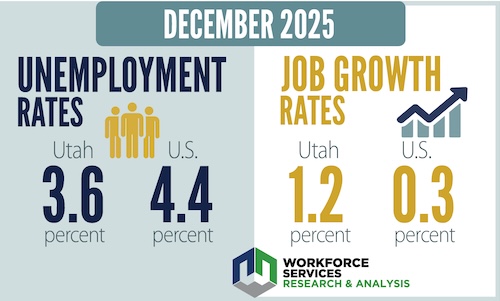
By August 2020, Utah’s unemployment rate plummeted to 4.9% (vs. 8.4% nationwide). By December 2020, it was 3.6% (vs. 6.7% nationwide). The national unemployment rate didn’t fall to 3.6% until 15 months later, in March 2022 (at which point Utah’s was 2.2%).
Although much of the U.S. has struggled with labor shortages (millions of workers still haven’t come back into the workforce since the pandemic began), Utah’s workforce grew substantially. If the rest of the U.S. had followed the same path, 5 million more Americans would be working today.”
If Utah’s outcomes are so strong, why haven’t other states followed its model? The main reason is that federal law has long made this kind of integration difficult. Utah can offer a more streamlined, customized system because it received two major exemptions under the federal Workforce Innovation and Opportunity Act. That said, Congress may be moving toward granting greater flexibility, and agencies may soon be more open to waiver authority, which would allow other states to test similar reforms.
The One Door to Work model cuts through the silos and the bureaucratic maze that allow fraud to go undetected. And it strengthens oversight on the front end, helping prevent fraud before taxpayer dollars are lost rather than trying to recover funds after the fact. That approach is better for public trust, for taxpayers, and for the people the social safety net is meant to serve.
Learn more about the One Door to Work model.