The Alliance for Opportunity (A4O) has completed a comprehensive study on the effectiveness of Arkansas’s workforce and safety net (welfare, public assistance) programs. The study paves the way for a statewide workforce strategy and a system that focuses on people rather than programs.
Arkansas legislators on the ALC-Hospital, Medicaid, Developmental Disabilities Subcommittee commissioned the study to help them understand current outcomes and consider ways to modernize and improve programs, which currently operate separately from each other. They are striving to make positive changes that will bring greater hope and opportunity to Arkansans who need a helping hand and a pathway to work.
A4O is a multi-state, nonprofit coalition that conducts research on the safety net in states like Utah, Georgia, and Louisiana, among others. The Georgia Center for Opportunity co-founded A4O with the Pelican Institute for Public Policy and the Texas Public Policy Foundation. As part of its work, A4O uses evidence-based research methods to understand how well workforce and safety net programs are working—both for the agencies administering them and for the people they serve. After determining that the state’s auditors weren’t able to undertake the project, Arkansas legislators sought out A4O’s assistance with the study because of its team members’ significant expertise in workforce modernization and welfare policy and their experience in identifying ways to improve government assistance and workforce services. To complete the study, A4O entered into a fee-for-service arrangement with the state of Arkansas.
Major Findings from the Study
To complete the study, A4O relied on publicly-reported state and federal information. The legislature also requested updated data and additional information not available publicly. A4O interviewed key administrators, managers, supervisors, and front-line staff to better understand how Arkansas’s welfare and workforce systems operate in practice. The team conducted the interviews in small, medium, and large counties and offices to make sure their analysis addressed the delivery of services statewide.
Through the study, the A4O team uncovered several significant findings:
- Labor Force Participation Rates Are Low: Low labor force participation rates have had devastating impacts throughout Arkansas, both on low-income citizens and employers. Arkansas has an overall labor force participation rate of 58.5%, which consistently ranks the state among the bottom 10 in the United States. An astonishing 202,000 prime-working-age Arkansans are not engaged in the workforce at all. And last year, 377,312 Arkansans were dependent on Supplemental Nutrition Assistance Program (SNAP or food stamps) benefits. Around 1.1 million Arkansans also relied on Medicaid and the Children’s Health Insurance Program (CHIP).
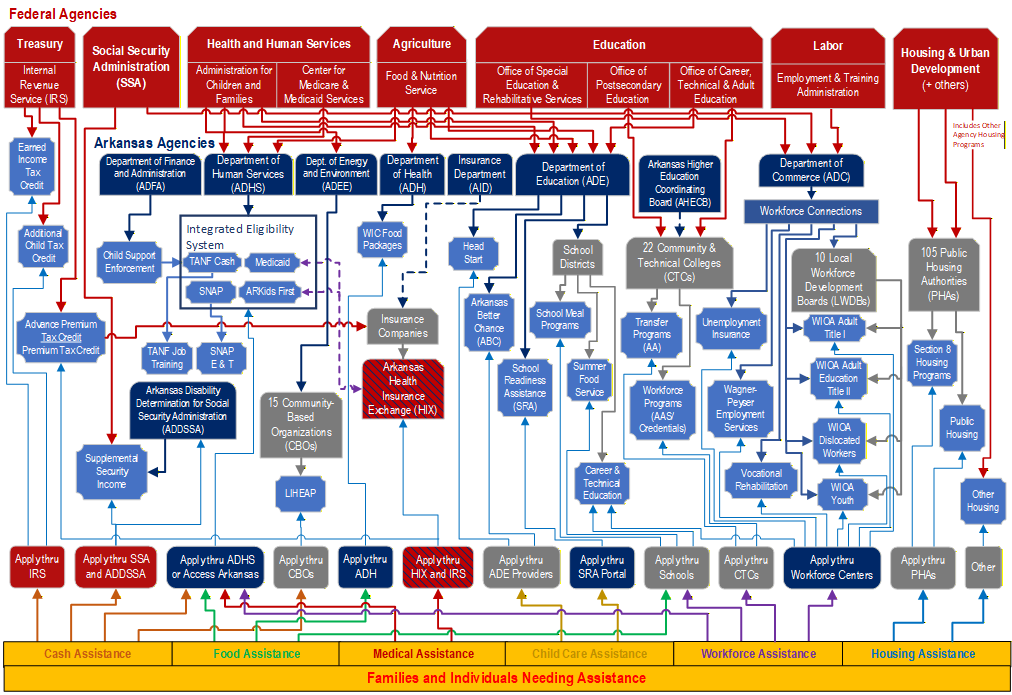
- Customers Who Need Workforce Support Are Stuck in Silos: Customers who need multiple workforce services and supports often struggle to receive them, and opportunities for upward mobility are limited. Arkansas also does not have a comprehensive workforce system to tackle significant challenges, such as improving labor force participation or addressing the impacts of artificial intelligence and other new technologies.
- Human Services Approach Does Not Focus on Work: Customers who rely on government assistance are trapped in poverty while caseloads and expenditures remain high. And as Arkansas implements work requirements, customers in the human services programs have no direct line to workforce programs. State agencies also address these requirements on a program-by-program basis instead of comprehensively.
- System Struggles with Significant Inherent Inefficiencies: Arkansas is “leaking” millions of dollars that could be redirected from administration to customer services for both businesses and workers. As federal resource constraints grow, Arkansas will be saddled with overhead and forced to implement dramatic reductions in the staff and services that support business and individual customers.
Key Recommendation: Create a Statewide Workforce Strategy That Integrates Welfare and Workforce Programs
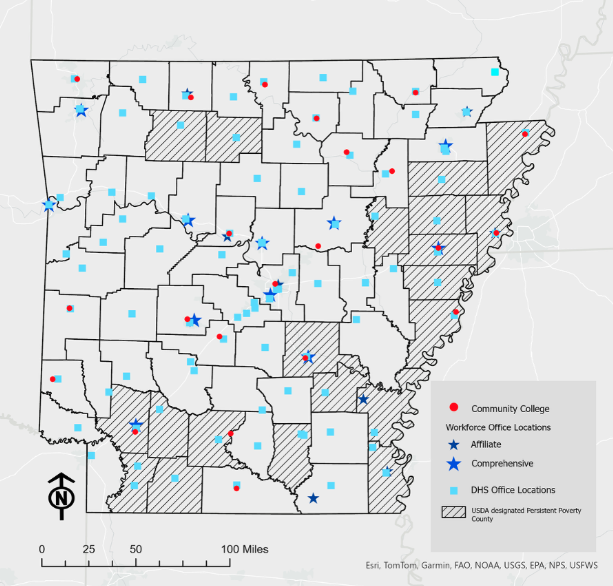
Through the study, A4O found that government assistance programs in Arkansas, including SNAP and Medicaid, aren’t connected to the state’s job training and placement services. As a result, people who apply for government benefits don’t receive the equally valuable help to develop a training or employment plan without going through a separate door, separate eligibility process, and separate caseworker.
To address this barrier to work, A4O suggests that Arkansas leaders adopt a “One Door to Work” strategy, which would connect the state’s public assistance and workforce development programs. Arkansas could then create a single cabinet-level agency to administer the more cohesive system. The integrated programs would deliver services consistently across the state, and all eligibility systems and financing would be consolidated as well.
The new system would also emphasize the importance of work at each step in the process of providing services. This would empower caseworkers to not only support people’s immediate needs but also help them find rewarding jobs and rise above the poverty level.
The One Door approach offers the framework to make this possible, not only for people in Arkansas but also for those who are struggling across the country. The opportunity to receive both welfare and workforce support by passing through one open door could give people nationwide a greater sense of dignity, clarity, and accountability as they pursue work, strive for economic independence, and ultimately flourish.
Additional One Door to Work Resources
How Do We Know the One Door Model Works?
Alliance for Opportunity
One Door to Work: Real-World Integration Between Safety Net and Workforce Systems
Alliance for Opportunity
One Door to Work: Myth vs. Fact
Alliance for Opportunity
Utah Department of Workforce Services: a System Integration Model
American Enterprise Institute
A Better Way to Get Welfare Recipients Back into the Labor Force
City Journal
The One Door Model: A Solution to Improve Economic Opportunity for Safety Net Participants
Georgia Center for Opportunity
A Path from Welfare to Self-Sufficiency
Governing
The Safety Net “System” That Isn’t
Governing
Unlocking Opportunity – How Pelican Institute Brought “One Door” to Louisiana
Pelican Institute for Public Policy